Kitchen storage that works: drawers, larders and clever corners
Most kitchens don’t need more cupboards — they need better ones. How to plan storage around what you own, so everything has a place and the worktops stay clear.
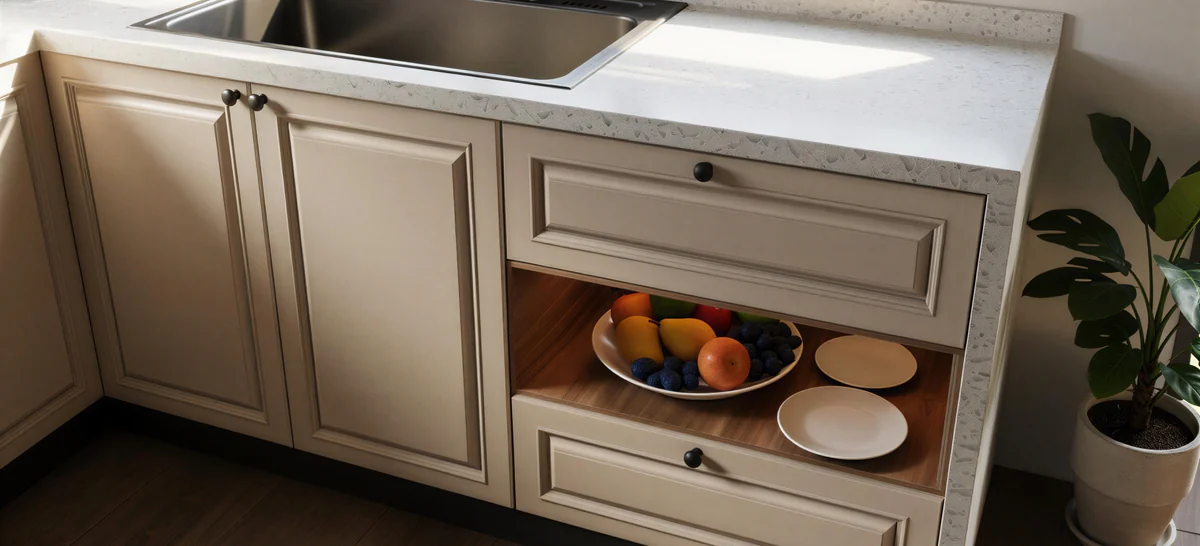
Ask anyone what frustrates them about their kitchen and storage comes up first: crowded worktops, cupboards where things disappear at the back, and a corner nobody can reach. The answer usually isn’t more units. It’s planning the storage around what you own and where you use it.
Make a list before a drawing
Before any design, we ask clients to go through their kitchen. How many pans and baking trays? Which small appliances are used every day, and which come out twice a year? How much food is bought in one shop? Those answers decide how many drawers you need, how deep they should be and whether a larder is worth the space.
Drawers beat cupboards
Low cupboards with a single shelf mean kneeling down and taking everything out to reach the back. Deep drawers bring the contents to you, and you can see everything from above. A typical bank of three — a shallow top drawer for cutlery and utensils, and two deep ones for pans and pots — is often the most useful unit in the kitchen. Internal drawers hidden behind a single door give the same benefit with a calmer look.
Store things where you use them
- By the hob: pans, oils, spices and utensils.
- By the sink and dishwasher: plates, glasses and cutlery, so unloading is one step.
- By the kettle: mugs, tea and coffee — or a dedicated drinks station.
- By the door: a drop zone for keys, post and the shopping.
The larder
A larder keeps all your dry food in one place. Full-height pull-out larders bring tins and jars out to you in one movement; a walk-in or reach-in larder cupboard with shallow shelves on the doors and inside shows everything at a glance. Even a slim 30cm pull-out beside the cooker holds a surprising amount.
Shallow is better for food. Shelves around 30cm deep stop jars hiding behind each other. Deep shelves suit bulky items, not groceries.
Corners
Corners are where most kitchens lose space. Swing-out and pull-out corner fittings bring the contents into reach, and in some layouts a corner drawer unit uses the space better still. If a corner really can’t be reached easily, it can become a home for things you use once a year.
The forgotten spaces
- Plinths: shallow drawers in the kickboard hold baking trays, placemats or a step stool.
- Above wall units: take the cabinets to the ceiling for seasonal items and dust-free storage.
- Appliance garages: a pocket or lift-up door hides the toaster and coffee machine but keeps them plugged in.
- End panels: slim open shelving for cookbooks or oils turns a blank side into something useful.
Inside the drawers
Cutlery inserts, peg boards for plates, spice racks and dividers for lids make a drawer work twice as hard. Planned at the same time as the units, they’re sized exactly to the drawer — and to what you’ll keep in it.
A kitchen with the right storage feels bigger, calmer and quicker to use. Start with what you own, and design every drawer around it.
Keep reading
-
 Kitchens
Bespoke vs. off-the-shelf kitchens: what you’re really paying for
A fitted kitchen is one of the biggest investments in a home. Here’s where bespoke genuinely earns its price — and where a standard range will do just fine.
4 min read Read article -
 Kitchens
Island, peninsula or galley? Choosing the right kitchen layout
Before choosing a single door colour, decide how the room should flow. How to pick the layout that suits your space and the way you cook.
4 min read Read article -
 Kitchens
Quartz, granite, porcelain or timber: choosing a worktop you won’t regret
The worktop takes more wear than any other surface in your home. How quartz, granite, porcelain, timber and laminate really compare.
4 min read Read article