Handleless kitchens explained: true handleless, J-pull and push-to-open
Handleless kitchens give clean, unbroken lines — but there are several ways of opening a door without a handle, and they feel quite different to live with. Here’s how they compare.
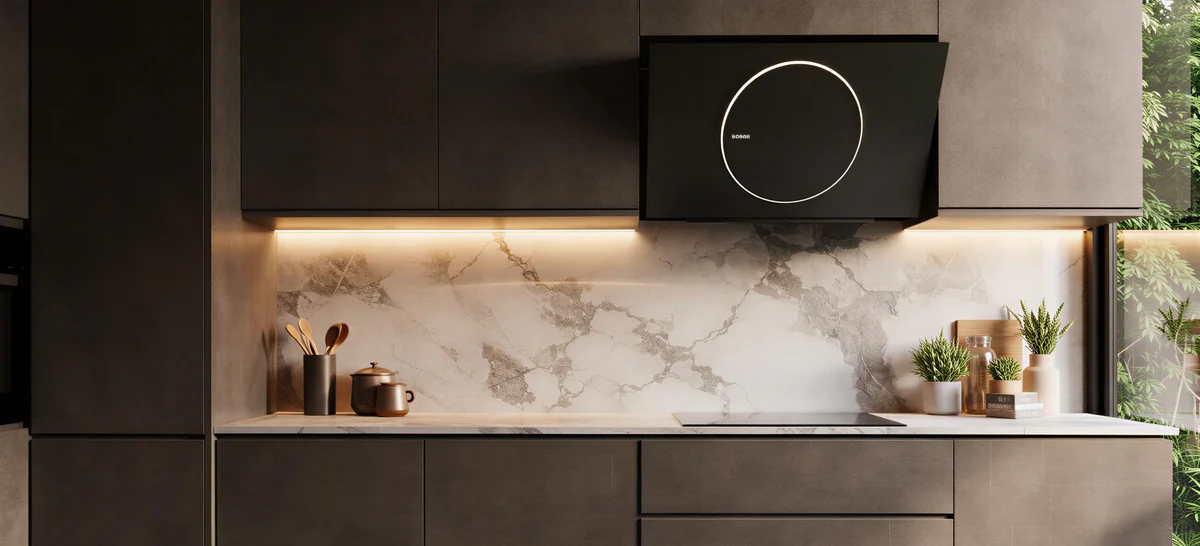
Handleless kitchens have become one of the most popular styles we make. Without handles breaking up the fronts, a run of cabinets reads as one calm surface — perfect for open-plan rooms where the kitchen is also part of the living space. But “handleless” covers several different systems, and it’s worth understanding them before you choose.
True handleless
In a true handleless kitchen, a recessed channel runs horizontally along the cabinetry, usually just below the worktop and between rows of drawers. The doors sit slightly below it, so your fingers slip into the channel to open them. The rail is often aluminium, finished in a colour that matches or contrasts with the doors, and it can be lit with a slim LED for a beautiful line of light.
It gives the cleanest, most architectural look and it’s comfortable to use every day. Because the channels are part of the carcass, it needs to be designed in from the start.
J-pull
A J-pull door has a lip shaped into its top edge, so the door itself forms the grip. It gives a similar minimal look at a lower cost, and suits a wide range of finishes. The shaped edge is visible from the side, which some people love as a detail and others prefer to avoid.
Push-to-open
Push-to-open mechanisms open a door with a gentle press. They’re ideal for wall cabinets, tall larders and units that hold lighter things, and they leave the fronts completely plain. For heavy pan drawers, a rail or J-pull is usually more practical, and electrically assisted opening systems are worth considering for large drawers.
Integrated and edge handles
Between handleless and handled sits a family of slim, integrated profiles: a fine metal edge along the top of the door, or a narrow recess routed into it. They keep the clean look but give a definite grip, and can add a subtle accent in brass, bronze or black.
Think about who uses the kitchen. Small children, older relatives and anyone with stiff hands may find some systems easier than others. Try them in a showroom, or on samples, before deciding.
Finishes that suit handleless
Without handles, your hands touch the doors themselves, so the finish matters. Matt and super-matt surfaces show far fewer fingerprints than gloss and many are anti-fingerprint by design. Wood veneers and textured finishes are forgiving too. Gloss looks striking but needs wiping more often.
Which is right for you?
- True handleless for the cleanest lines and a premium, architectural feel.
- J-pull for the handleless look at better value.
- Push-to-open for wall cabinets, tall units and hidden doors.
- Integrated profiles if you want a minimal look with a definite grip.
Many of our kitchens mix systems — a rail on the base units, push-to-open above — so each door works in the best way for what it holds. The result is a kitchen that looks seamless and feels effortless to use.
Keep reading
-
 Kitchens
Bespoke vs. off-the-shelf kitchens: what you’re really paying for
A fitted kitchen is one of the biggest investments in a home. Here’s where bespoke genuinely earns its price — and where a standard range will do just fine.
4 min read Read article -
 Kitchens
Island, peninsula or galley? Choosing the right kitchen layout
Before choosing a single door colour, decide how the room should flow. How to pick the layout that suits your space and the way you cook.
4 min read Read article -
 Kitchens
Quartz, granite, porcelain or timber: choosing a worktop you won’t regret
The worktop takes more wear than any other surface in your home. How quartz, granite, porcelain, timber and laminate really compare.
4 min read Read article